Halong tours - Driven by the strong determination of local authorities and the collaborative efforts of the business community and tourists, environmental protection and plastic waste reduction initiatives in Halong Bay are yielding positive results, helping to preserve the landscape and environment of this heritage site.
Halong Bay, a World Natural Heritage site, is not only a source of pride for Quang Ninh but also an invaluable treasure for Vietnam and the world. To protect the bay's environment, Quang Ninh has issued and implemented various major policies in recent years to enhance heritage protection. These include relocating all floating fishing village residents to the mainland; prohibiting fishing within the heritage site's core zone; zoning aquaculture areas outside the heritage site; and improving the quality, safety, and operational efficiency of tourist vessels while reducing their overall numbers.
Notably, since September 1, 2019, the Management Board of Halong Bay – Yen Tu World Heritage Site has implemented the "Plastic-Free Halong Bay" program. The initiative encourages tourism service providers, travel agencies, and visitors to avoid using single-use plastic products while visiting the bay. Items such as plastic bottles, plastic bags, and plastic straws are gradually being replaced with suitable, eco-friendly alternatives.
At passenger ports, before boarding vessels to tour Halong Bay, visitors are advised against bringing or using single-use plastic products. Such reminders at ticket checkpoints encourage visitors to proactively adjust the items they carry, fostering a shared commitment to environmental preservation throughout their journey. Information regarding environmental protection is also disseminated via loudspeaker systems, signage, and visual materials at the port and tourist destinations.
Notably, on June 5 and 6, 2026, at the Halong International Cruise Port, authorities conducted an awareness campaign urging tourists not to bring plastic waste onto boats touring the bay, while also reminding boat owners to comply with regulations on limiting single-use plastic products. To help shift habits, authorities distributed non-woven fabric bags-as alternatives to plastic bags-to tourists boarding the sightseeing boats. Thanks to this proactive engagement, the majority of visitors responded enthusiastically, complying with the rules against bringing or using single-use plastic products while visiting the bay.
According to a report by the Management Board of the Halong Bay - Yen Tu World Heritage Site, 100% of businesses and households operating tourist boats and tourism services within the heritage site's core zone have signed a commitment to participate in the program. Single-use plastic waste resulting from tourism activities at sightseeing spots has been reduced by over 90%.
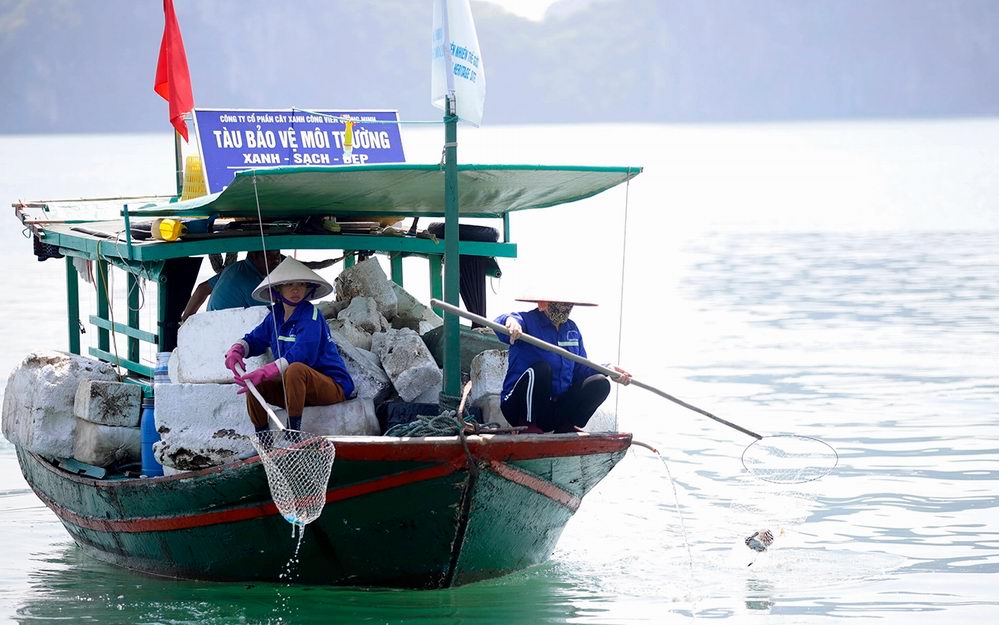
Authorities collecting floating waste on Halong Bay.
Beyond awareness-raising efforts, waste collection activities on the bay continue to draw active participation from various organizations and businesses. Since the beginning of the year, numerous cleanup campaigns have been organized in areas surrounding islands, at sightseeing spots, and in adjacent zones.
Notably, on May 23, the Youth Union of the Halong Bay - Yen Tu World Heritage Site Management Board collaborated with the Youth Union of Petrolimex Quang Ninh One Member Limited Liability Company to mobilize 30 people to clean up the Ang Du Island area, collecting approximately 20 cubic meters of waste. Subsequently, on May 28, the “Clean the Bay 2026” program-organized by Bhaya Cruises Co., Ltd. near the Ba Men Temple-attracted over 80 volunteers and resulted in the collection of more than 600 kg of various types of waste. On June 8, the Management Board of the Halong Bay - Yen Tu World Heritage Site collaborated with the Cat Ba Bay Management Board to collect over 20 cubic meters of waste from the areas of Hon Gom Giua and Hon Dam Nam, transporting it to the shore for proper disposal.
Alongside waste collection efforts in the bay, the replacement of polystyrene floats on floating structures is also proceeding. According to reports from the Halong Bay heritage management authority, 99% of the polystyrene floats on floating structures within the core zone have now been replaced with sustainable, eco-friendly materials.
Building on these achievements, the Halong Bay - Yen Tu World Heritage Site Management Board will continue to coordinate with relevant departments, agencies, and local authorities to control coastal waste sources and prevent waste from spreading into the bay. Waste sorting must be integrated with synchronized collection, transportation, and treatment processes. As reducing single-use plastics becomes a standard practice across cruise operations, service activities, and community life, the preservation of the Halong Bay environment will rest on a more sustainable foundation.
Source: https://halong-tour.com/travelnews/key-policies-and-community-efforts-preserving-halong-bay.php
