Private Vietnam tour - The "kings" of the northern mountainous region: Vuong Chi Sinh, Hoang A Tuong, and Deo Van Long were once glorious under the protection of the French colonialists.
After the collapse of the colonial-feudal regime, these "kings" also "took their hats and left", but their mansions, built with the sweat and tears of the people, remain, becoming cultural landmarks for future generations to learn about a bygone era...
The Vuong family mansion
Anyone who has ever set foot in Dong Van (Ha Giang) - the northernmost point of the country - cannot miss visiting the Vuong family mansion located in the Sa Phin valley. The mansion was built during the time of Vuong Chinh Duc - a high-ranking official appointed by the protectorate government to govern this strategically important border region of Vietnam.
Located on the opium trade route from southwestern China to Myanmar, Vietnam, and other Southeast Asian countries, Dong Van, with an average altitude of over one thousand meters above sea level and a rocky mountainous terrain, was ideal for growing opium poppies. Vuong Chinh Duc became a crucial link in the opium trade, suddenly becoming wealthy and powerful, proclaiming himself the "king" of the Hmong people in Ha Giang.
The Vuong family mansion was built in the late 19th century by more than 300 Hui (Chinese) craftsmen on a tortoise-shell-shaped mound in the middle of the Sa Phin valley, chosen by a Chinese geomancer.
The architecture of the complex is strongly influenced by Chinese feudal architecture, comprising a front, middle, and rear building. Connecting the three two-story wooden houses with rammed earth walls (the architecture of the Mong, Dao, Pa Di, Ha Nhi... ethnic groups in the high mountains) is a stone-paved courtyard. The "king's" residence is the innermost house with stone walls, behind which is an escape tunnel. All the houses are roofed with yin-yang tiles, some decorated with opium poppy flowers, which are believed to have helped Vuong Chinh Duc become the "King of the Hmong" in the border region. Surrounding the mansion is a 0.8m thick stone wall with numerous loopholes and guard towers. From a military perspective , it served as both a residence and a fortified stronghold in times of conflict.
When Vuong Chinh Duc passed away, he handed over power to his second son, Vuong Chi Sinh. When the August Revolution of 1945 broke out, Vuong Chi Sinh's troops, in coordination with the Viet Minh Front, drove the French forces out of Ha Giang. After the revolution's success, President Ho Chi Minh invited Vuong Chi Sinh to join the first National Assembly and they became sworn brothers, changing his name to Vuong Chi Thanh and presenting him with a precious sword, its scabbard engraved with eight characters: "Utmost loyalty to the nation/Never to be enslaved."
Hoang A Tuong Mansion
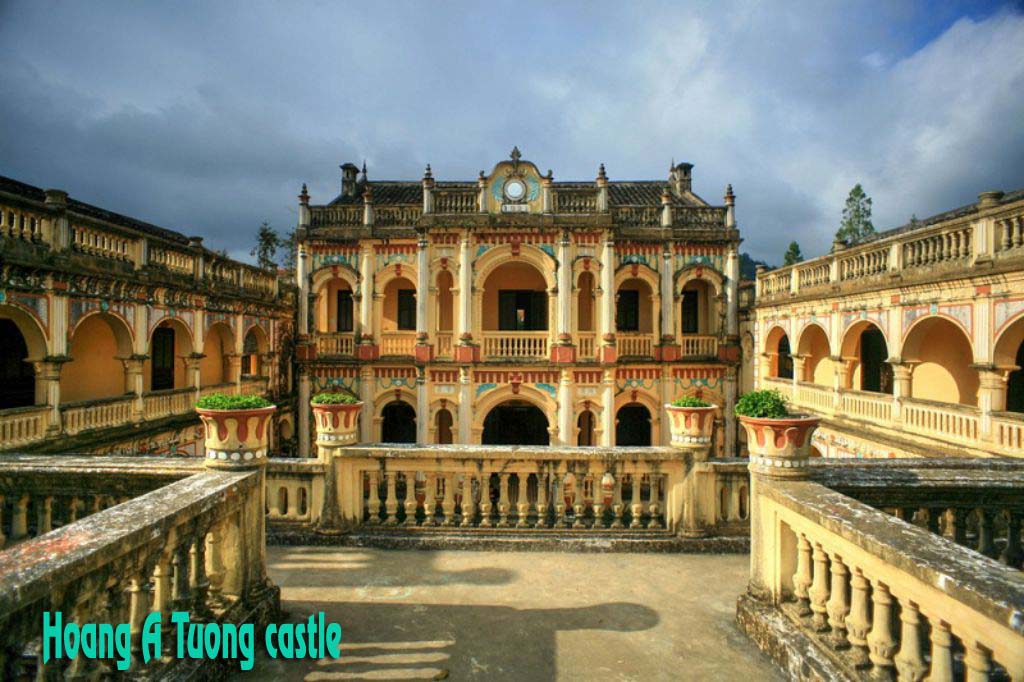
The Hoang A Tuong mansion is located in Bac Ha town, Lao Cai province, on the road to Si Ma Cai. Hoang A Tuong was of the Tay ethnic group, but ruled over a region where over 80% of the population was Hmong, earning him the nickname "King of the Hmong". Hoang A Tuong was the son of Hoang Yen Chao, a local chieftain of the Bac Ha plateau. Before the liberation of Lao Cai (November 1950), Bac Ha was not only a Silk Road connecting to Yunnan via Central Asia, but also a transit point for opium from Central Asia through Indochina to South Asia and vice versa. Hoang A Tuong collected 500 kg of opium annually from the people, forcing them to sell another 500 kg cheaply, leading the opium and other goods trafficking network across Asia via Bac Ha.
The Hoang A Tuong mansion faces southeast, its back against Co Tien Mountain, in accordance with the Chinese feng shui principle: "leaning against the mountain and stepping on the water", creating a very stable position. The architecture of the mansion combines the ancient French architectural style of the 17th-18th centuries with the stilt house architecture of the Tay people, harmoniously standing out amidst the majestic mountains.
The mansion of Hoang A Tuong was built over a period of eight years (1914-1921), using materials including locally sourced stone, lime, sand, and molasses, while cement and steel were transported by plane and pack horses from Hanoi and Lao Cai.
Deo Van Long Mansion
The Deo Van Long mansion is located at the confluence of the Da River, the Nam Na River, and the Nam Lay stream; formerly part of Le Loi ward, Lai Chau town (old), after Lai Chau was divided into two provinces, Lai Chau and Dien Bien, the Deo Van Long mansion is now located in Le Loi commune, Sin Ho district, Lai Chau province.
According to historical documents , Deo Van Long was the son of Deo Van Tri, who governed twelve Thai territories (Sipsong Chuthai). In the late 19th century, Deo Van Tri responded to the Can Vuong Proclamation, leading the Thai ethnic group and several other ethnic groups in the Lai Chau region to revolt against the French. After being persuaded, Deo Van Tri surrendered to the French, paving the way for their advance into Muong Thanh. The French then restored Deo Van Tri's rule over the Sipsong Chuthai region on the banks of the Da River, allowing for hereditary succession.
The Deo Van Long mansion was built in a strategically important location, with high mountains behind it and a wide river in front. This crucial position allowed him to control the routes to Phong Tho, Sa Pa, Muong Te, and down to Hoa Binh, as well as through Dien Bien to Laos.
After the victory at Dien Bien Phu, Deo Van Long fled to France with his wife and children. Deo Van Long's mansion, left uninhabited, fell into ruin over time. What remains shows that the architecture of the complex was a combination of the stilt house architecture of the Thai people and French architecture. The main house was a two-story structure built of red brick with wooden floors. Surrounding the main house were smaller buildings for residents and soldiers, enclosed by a thick brick and stone wall over 40cm thick with many loopholes, and over 3m high. In front of the complex was a large courtyard for traditional dances during celebrations. The roof tiles were made from slabs of stone - which the locals called "paper stone" - soft enough to be cut with a knife when first separated, but hardening like earthenware when exposed to the sun.
Previously, Lai Chau province had planned to restore the Deo Van Long mansion, but when the Son La hydroelectric project was implemented, the entire Deo Van Long mansion complex would be submerged under the reservoir. After October 2010, when the water level of the Son La reservoir rises, the entire mansion of this "Thai king" would be underwater.

No comments:
Post a Comment